If you’ve been buying HDPE lately, you’ve probably noticed the numbers creeping up. Over the past year, prices have climbed 15–20%, and for anyone running an IBC tank production line, that hits right where it hurts. Raw material is already 60–70% of your production cost—when that goes up, your margin gets squeezed fast.
There’s not much any of us can do about global resin prices. But here’s the part you can control: how efficiently you use that material.
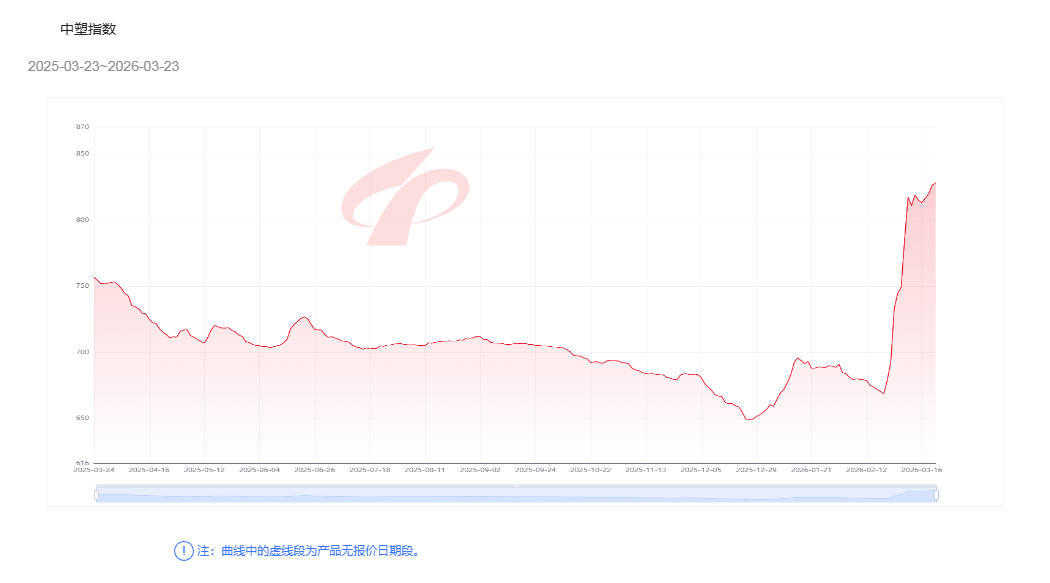
2025.03.23-2026.03.23 Plastic Particle Price Trend Chart
When HDPE prices are high, your blow molding machine becomes one of the most important tools for protecting your bottom line. Not because it changes the market—but because it changes how much material you burn through to make each tank.
This article walks through three practical ways the right equipment can help you save material, cut waste, and keep your energy bill under control. And we’ll also look at one of the most effective strategies we’re seeing right now: three-layer IBC tank production, which lets you stretch every kilogram of new material further.
First, Let’s Talk Numbers
A standard 1,000-liter IBC tank uses about 45–55 kg of HDPE. If resin prices go up by just $0.10–0.20 per kg, that’s an extra $4.50–$11.00 per tank. Run 100,000 units a year, and suddenly you're looking at half a million to over a million dollars in added material cost.
That's real money.
So the question isn't whether you want to control costs—it’s where you can actually make a difference. The answer is usually sitting right on your production floor: your blow molding machine.
Modern machines can help you tackle the three biggest sources of waste in IBC production:
· Making each tank heavier than it needs to be, just to be safe
· Losing parts to scrap because the process isn’t stable
· Burning more electricity than necessary
Let's look at each one.
1. Stop Using More Material Than You Actually Need
The Problem
A lot of older machines rely on the operator’s judgment to set wall thickness. And because nobody wants to risk a thin spot that causes a failure, the natural tendency is to run a little heavier than required. Safe? Yes. Efficient? Not really.
That “extra bit of safety” adds up. Across thousands of tanks, it becomes tons of unnecessary HDPE going out the door.
What Helps
Modern IBC blow molding machines come with servo-driven wall thickness control. Think of it as a programmable system that lets you put material exactly where it’s needed—thicker at the bottom and corners where stress is highest, thinner in areas that don’t carry much load.
The machine doesn’t guess. It follows the program precisely, cycle after cycle, with accuracy down to ±0.1 mm.
What That Means for Your Cost
· Weight reduction: 5–8% less material per tank
· Annual savings: If you produce 100,000 tanks a year, that’s 250–400 tons of HDPE saved
· Dollar impact: At today’s prices, that’s $250,000–$500,000 back in your pocket
If you’ve never looked at how your current wall thickness compares to what’s actually required, this is worth a conversation.
2. Scrap Is Just Money Going in the Bin
The Problem
Every rejected tank means you’ve already paid for the material, run it through the machine, and spent labor on it. Then you toss it. Industry average scrap rates for IBC production run 3–5%, which feels normal—until you do the math.
Common causes: inconsistent wall thickness, weak weld lines, temperature swings, unstable hydraulics. Small variations that shouldn’t happen, but do.
What Helps
The machines that keep scrap low are the ones that keep everything stable. Closed-loop controls monitor temperature, pressure, and speed in real time, making small adjustments automatically. Multi-zone mold temperature control keeps cooling consistent. And automated handling with basic vision inspection catches defects early, before they turn into piles of rejects.
It’s not about fancy automation for its own sake—it’s about reducing the variability that creates scrap.
What That Means for Your Cost
· Scrap rate down: from 3–5% to 1–2%
· More sellable units: On 100,000 tanks, that’s 2,000 extra units per year
· Material not wasted: those 2,000 tanks would have consumed 90–110 tons of HDPE that now actually generate revenue
3. The Big One: Three-Layer Production That Stretches Your Material
Here’s where things get really interesting.
One of the most effective ways to cut material costs isn’t just about using less—it’s about using cheaper material where it doesn’t affect performance.
Enter three-layer IBC tank production.
Instead of making the entire tank from virgin HDPE, a three-layer co-extrusion blow molding machine lets you build the tank with a sandwich structure:
· Inner layer (about 20%): Virgin HDPE. This layer is in direct contact with the contents, so it needs to be clean, pure, and chemically resistant.
· Middle layer (about 60%): Recycled material. This can be your own internal scrap—deflashing from production, rejected tanks that didn’t pass quality, even post-industrial regrind. The middle layer provides bulk and strength without needing to be virgin quality.
· Outer layer (about 20%): Virgin HDPE plus color masterbatch. This gives you a clean, consistent appearance, UV protection, and a professional finish.
Think of it like plywood. The core doesn’t need to be premium—it just needs to be solid. The surface layers handle the demands that matter for appearance and product contact.
Why This Works So Well
· You recycle your own scrap on the spot. Instead of selling deflashing and rejected tanks at a discount, you grind them and feed them right back into the middle layer.
· Virgin material goes further. With only 40% virgin content (inner + outer) instead of 100%, you cut your virgin HDPE consumption by more than half.
· Performance stays high. The inner layer still gives you the chemical resistance and purity you need. The outer layer gives you UV stability and a consistent look.
What That Means for Your Cost
Let’s run the numbers. If virgin HDPE is $1,500 per ton and recycled material is $800 per ton, and you’re producing 5,000 tons of finished tanks per year:
· 100% virgin: 5,000 tons × $1,500 = $7,500,000
· 40% virgin + 60% recycled: (2,000 tons × $1,500) + (3,000 tons × $800) = $3,000,000 + $2,400,000 = $5,400,000
That’s a $2.1 million annual saving on material alone.
And because you’re using your own scrap, the recycled material cost is even lower—you’ve already paid for it once.
What You Need to Make It Work
Three-layer production requires a co-extrusion blow molding machine with three extruders feeding into a multi-layer die head. It’s more investment upfront, but the payback is fast—often under a year, depending on your production volume and scrap generation.
If you’re already running IBC production and generating scrap, this is one of the highest-ROI upgrades you can make.
4. Energy Costs Add Up Faster Than You Think
The Problem
Blow molding is energy-intensive. Traditional hydraulic machines run fixed pumps that keep going even when the machine is idle. Heaters stay on. Screw drives run at full power regardless of demand.
Electricity isn’t getting cheaper. And every kilowatt-hour you use is another line item cutting into margin.
What Helps
Servo-hydraulic systems are a game changer here. Instead of running a pump constantly, they deliver power only when it’s needed—like an engine that idles instead of racing. Savings of 30–50% are typical.
Add in efficient screw and barrel designs that melt faster with less energy, and standby modes that cut power during breaks or mold changes, and the difference becomes significant.
What That Means for Your Cost
· Energy use per ton: drops from 800–1,000 kWh to 500–600 kWh
· Annual savings: A line producing 5,000 tons per year saves about 1.5 million kWh. At $0.12/kWh, that’s $180,000 a year.
That’s not a small number. And it comes straight off your utility bill.
So What Does This Look Like Side by Side?
Here’s a quick comparison between a traditional hydraulic single-layer machine and a newer three-layer servo machine:
| Traditional Single-Layer | Three-Layer Servo Machine |
Virgin material content | 100% | 40% |
Material cost per ton | $1,500 | ~$1,080 |
Part weight | Baseline | 5–8% lower |
Scrap rate | 3–5% | 1–2% |
Energy use | Baseline | 30–50% lower |
Payback Example
Let’s say a three-layer co-extrusion machine with servo hydraulics costs $300,000 more upfront than a basic single-layer machine. Between material savings (using 60% recycled content), lower part weight, reduced scrap, and lower energy bills, you’re looking at $400,000–600,000 in annual savings. Payback is typically under 12 months.
After that, it’s just a better cost structure—and a more sustainable operation.
How to Choose the Right Partner
If you're thinking about equipment upgrades or moving to three-layer production, here’s what to look for in a supplier:
· They know IBC tanks. General blow molding experience is helpful, but IBCs have their own demands—big parts, high output, consistent wall control, and multi-layer capability. You want someone who’s done this before.
· They understand material and recycling. The transition to three-layer isn’t just about hardware. You need someone who can help you dial in the process for recycled content, manage layer ratios, and ensure bonding between layers.
· They’re there when you need them. Downtime is expensive. Local or regional service support matters more than a glossy brochure.
For what it’s worth, we cover all of this—equipment, material matching, and compatible fittings. Our view is that everything should work together, so you’re not piecing together solutions from three different vendors.
The Bottom Line
You can’t control HDPE prices. But you don’t have to just take the hit, either.
With the right blow molding machine and the right production strategy, you can:
· Use 5–8% less material per tank
· Cut scrap from 3–5% down to 1–2%
· Shift from 100% virgin to just 40% virgin with three-layer technology
· Shave 30–50% off your energy bill
Those savings add up fast. And in most cases, they pay for the equipment within a year or two—while leaving you with a more efficient, more sustainable, and more profitable production line.
If you’re curious about how your current line compares, or want to run the numbers for three-layer production with your own scrap volume, reach out. We’ll send over a simple savings estimate—no hard sell, just the math.
We’re in this business too. And we know that in a high-cost market, every dollar saved is a dollar that stays in your pocket.


