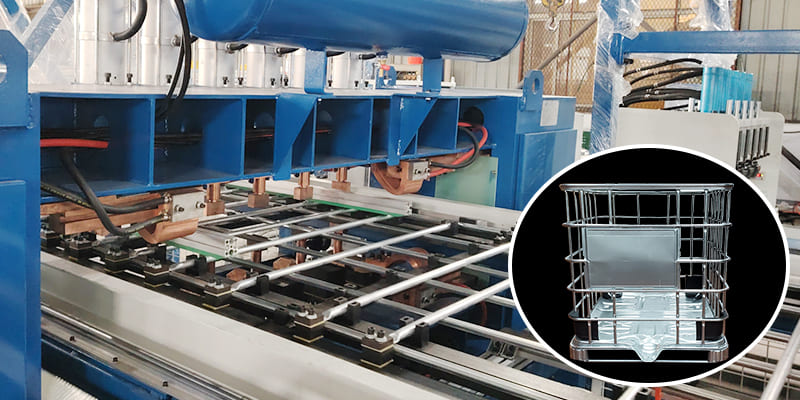
In the global supply chains of chemical, food, and pharmaceutical industries, Intermediate Bulk Container (IBC) cages serve as the critical backbone for safe liquid and powder transportation. The durability, compliance, and cost-effectiveness of an IBC cage hinge on one core manufacturing process: precision welding. This comprehensive guide explores modern IBC cage welding technology, automated solutions, and how to select equipment that maximizes production quality and efficiency.
Understanding IBC Cage Construction & Welding Requirements
Anatomy of an IBC Cage
Every IBC cage consists of several critical components requiring precise joining:
Core Structural Elements:
· Four vertical corner posts (primary load-bearing columns)
· Top and bottom rectangular frames
· Horizontal and vertical wire mesh grid
· Door assembly with reinforced hinges
· Fork pocket channels for material handling
Why Welding Quality is Non-Negotiable:IBC cages must withstand brutal conditions—stacking under immense weight, constant vibration during transportation, and exposure to harsh environments. Every weld point becomes a potential failure point if not executed correctly. Consistent, high-quality welding directly impacts:
· Load capacity and stacking stability
· Compliance with UN certification for hazardous materials
· Operational safety throughout container lifespan
· Total cost of ownership through reduced failures
The Critical Welding Challenges
Manufacturers face several technical hurdles:
Heat Distortion Management: Uneven heating causes frame warping, leading to assembly issues with plastic bottles or liners.
Consistent Penetration: Achieving uniform weld penetration across hundreds of weld points per cage, especially where wires intersect frames.
Production Throughput: Manual welding cannot meet volume demands of modern supply chains.
Material Variability: Working with both galvanized and powder-coated wires requires different welding parameter sets.
Types of IBC Cage Welding Machines & Production Lines
1. IBC Cage Frame Welding Machines
These specialized systems focus on the structural foundation—joining corner posts to top and bottom frames with robotic precision.
How They Work:
· Multi-head welding stations simultaneously weld all four corners
· Precision jigs and fixtures eliminate human positioning errors
· Servo-controlled clamping maintains alignment during welding
· PLC programs store parameters for different cage sizes
Key Advantage: Complete squareness and dimensional accuracy in under 60 seconds, compared to 5+ minutes with manual welding.
2. IBC Tote Cage Welding Lines
For complete cage assembly, manufacturers implement semi or fully automated welding lines.
Semi-Automatic Lines:
· Ideal for medium-volume production or multiple product variants
· Operators load components; automated stations handle welding sequences
· Quick changeovers between cage sizes (typically under 15 minutes)
· Perfect balance between automation investment and flexibility
Fully Automatic Lines:
· Complete turnkey solutions for high-volume production
· Automated material handling systems feed wire mesh and frame components
· Robotic positioning and transfer between welding stations
· Unmatched output: 80-120 complete cages per hour
· Integrated quality monitoring systems at each station
A Real-World Comparison:Manual Operation: 8-10 cages/hour with 2 skilled weldersSemi-Auto Line: 25-40 cages/hour with 1 operatorFull Auto Line: 80-120 cages/hour with minimal supervision
3. Specialized Welding Stations
Door Hinge Welders: Ensure perfect alignment and consistent penetration on high-wear components.
Fork Pocket Welding Systems: Reinforce these critical stress points with automated precision.
Custom Fixturing Solutions: For non-standard cage designs or proprietary configurations.
Core Technologies Powering Modern IBC Cage Welders
Resistance Welding: The Industry Standard
Why it dominates IBC manufacturing:
· Speed: Each weld completes in milliseconds
· Energy efficiency: Only local heating at contact points
· No consumables: Unlike MIG/MAG welding
· Perfect for wire-to-frame joints
Advanced Controls Make the Difference:
· Constant current monitoring ensures consistent penetration
· Electrode force profiling adapts to material variations
· Auto-tip dressing maintains electrode surface quality
· Energy monitoring flags potential weak welds immediately
Robotic Arc Welding for Heavy-Duty Applications
Where MIG/MAG welding excels:
· Thicker frame materials exceeding 4mm
· Continuous seam welding requirements
· Special alloy materials needing specific filler metals
· Repair and rework stations
Intelligent Control Systems
Modern IBC welders incorporate sophisticated electronics:
PLC + HMI Integration: Stores hundreds of weld schedules for different cage models. Operators switch between recipes with one-touch simplicity.
Servo Positioning Systems: Achieve positioning accuracy within ±0.1mm, ensuring perfect alignment every cycle.
IoT Connectivity: Remote monitoring of production metrics, predictive maintenance alerts, and performance analytics.
The Transformative Benefits of Automation
Quality Transformation
Every cage identical: Automated systems eliminate human variability. Each weld receives identical parameters—pressure, current, duration.
Compliance simplified: Generate complete weld data logs for quality audits and certification requirements.
Reduced rework rates: Typical reduction from 5-8% with manual welding to under 0.5% with automation.
Economic Advantages
Labor cost reduction: One automated line replaces 6-8 skilled welders while increasing output.
Material optimization: Precise weld placement minimizes overwelding and reduces electrode consumption.
Energy efficiency: Modern medium-frequency welding transformers cut power consumption by 30-40% compared to traditional systems.
Operational Excellence
Safety enhancement: Remove operators from repetitive strain injuries and fume exposure.
Scalability: Modular designs allow adding stations as production needs grow.
Flexibility: Quick changeovers between different cage designs within minutes.
How to Choose: Your IBC Cage Welding Solution Guide
Step 1: Assess Production Requirements
Key questions to answer:
· Current and projected annual cage volume
· Number of different cage designs/sizes in production
· Available factory floor space and ceiling height
· Existing material handling infrastructure
Volume-Based Recommendations:
· Under 20,000 cages/year: Semi-automatic systems with manual loading
· 20,000-80,000 cages/year: Fully automatic single-line systems
· Over 80,000 cages/year: Multiple fully automated lines or integrated cells
Step 2: Evaluate Technical Specifications
Critical machine parameters:
· Maximum wire thickness capacity (typically 5-8mm)
· Number of simultaneous weld points
· Positioning accuracy and repeatability
· Changeover time between cage sizes
· Electrical requirements and power consumption
Step 3: Total Cost of Ownership Analysis
Look beyond initial investment:
· Maintenance requirements and spare parts availability
· Expected electrode life and replacement costs
· Energy consumption per cage
· Training requirements for operators and maintenance staff
· Potential integration costs with existing systems
Step 4: Supplier Evaluation Criteria
Essential vendor qualifications:
· Industry-specific experience with IBC manufacturing
· References from current customers with similar applications
· Engineering support from concept through installation
· Availability of training programs and documentation
· Local or responsive global service network
· Commitment to continuous improvement and updates
Huan Machinery: Engineering Excellence in IBC Welding Solutions
With years of specialized experience, Huan Machinery delivers precision-engineered solutions for IBC manufacturers worldwide. Our approach combines deep process knowledge with robust mechanical design.
Our Product Portfolio
High-Speed Frame Welders: Four-head simultaneous welding systems with automatic tip dressing and real-time quality monitoring.
Modular Welding Lines: Configurable from semi-automatic to fully automated systems based on your growth trajectory.
Complete Production Cells: Integrated solutions including material handling, welding, quality inspection, and stacking.
What Differentiates Our Solutions
Application-Specific Engineering: We don't offer generic welders. Every Huan Machinery system incorporates IBC-specific knowledge into its design.
Unmatched Durability: Industrial-grade components rated for continuous three-shift operation.
Intuitive Operation: Simplified HMIs with visual guides reduce training time and operator errors.
Global Support: Comprehensive documentation, remote diagnostics, and responsive technical support.
Success Story: Global Chemical Manufacturer
Challenge: Increase production from 45 to 85 cages/hour while improving weld consistency for UN certification.
Solution: Custom-designed fully automatic welding line with integrated vision inspection.
Results:
· Output increased to 92 cages/hour (104% improvement)
· Weld consistency achieved 99.8% compliance rate
· Labor requirement reduced from 9 to 3 operators per shift
· ROI achieved in 14 months through productivity gains
Industry 4.0 and Future Trends
Smart Manufacturing Integration
Predictive Maintenance: Vibration and thermal sensors detect developing issues before failures occur, reducing unplanned downtime by up to 70%.
Digital Twins: Virtual models of welding lines allow optimization and troubleshooting without disrupting production.
Data Analytics: Machine learning algorithms analyze weld quality trends to suggest parameter optimizations.
Sustainability Advancements
Energy Recovery Systems: Capture and reuse waste heat from welding transformers.
Material Optimization Algorithms: AI-driven nesting software minimizes wire mesh scrap rates.
Adaptive Welding Technologies
Vision-Guided Systems: Cameras verify component positioning before welding and inspect welds after completion.
Real-Time Parameter Adjustment: Systems automatically compensate for material thickness variations or coating differences.
Making the Transition: Implementation Best Practices
Phased Approach for Existing Facilities
Phase 1: Begin with a frame welding machine to establish quality foundationsPhase 2: Add semi-automatic mesh welding stationsPhase 3: Integrate material handling for full automationPhase 4: Implement data collection and analytics systems
Training & Knowledge Transfer
Comprehensive programs covering:
· Machine operation and recipe management
· Preventive maintenance procedures
· Basic troubleshooting and diagnostics
· Quality control and inspection protocols
Continuous Improvement Culture
Key performance indicators to track:
· Overall Equipment Effectiveness (OEE)
· First-pass yield percentage
· Mean time between failures
· Energy consumption per cage
· Changeover time between products
Conclusion: The Competitive Imperative
In today's demanding manufacturing environment, automated IBC cage welding isn't a luxury—it's a competitive necessity. The combination of consistent quality, increased throughput, and reduced operating costs creates compelling economic advantages.
Manual welding simply cannot meet the precision requirements of modern IBC applications or the volume demands of global supply chains. The transition to automated welding represents one of the highest-return investments an IBC manufacturer can make.
Next Steps with Huan Machinery
Ready to transform your IBC cage production? Our engineering team offers:
1. Free Process Evaluation: Analysis of your current operations with specific recommendations
2. Proof-of-Concept Testing: Validate welding parameters with your actual materials
3. Customized Proposals: Detailed solutions matching your production goals and budget
4. Customer Reference Visits: See our systems operating in facilities like yours
Contact us today to schedule your consultation and discover how Huan Machinery can elevate your IBC manufacturing capabilities.
Frequently Asked Questions
Q: What is the typical lead time for an automated IBC welding system?
A: Standard systems deliver in 3-4 months. Customized solutions typically require 4-6 months from design approval to factory testing.
Q: Can your systems handle both powder-coated and galvanized wires without changeover?
A: Yes, with our advanced welding controls, the system automatically adjusts parameters when switching between materials. Quick-change electrode configurations minimize transition time.
Q: What maintenance skills are required for your equipment?
A: Our systems are designed for maintenance by your existing technical staff. We provide comprehensive training covering daily, weekly, and monthly maintenance procedures.
Q: How do you ensure consistent quality across thousands of welds daily?
A: Multiple monitoring systems: constant current control, electrode force verification, energy monitoring per weld, and optional vision inspection systems.
Q: What is your typical customer ROI timeframe?A: Most customers achieve full ROI within 12-18 months through labor savings, quality improvements, and increased throughput. High-volume facilities often see returns in under 12 months.


