Home » About Us » HUAN News » Blog » IBC Tank Mold Design and Wall Thickness Control: The Hidden Factors Behind Strong Industrial Packaging
IBC Tank Mold Design and Wall Thickness Control: The Hidden Factors Behind Strong Industrial Packaging
Views: 1 Author: Site Editor Publish Time: 24-07-2026 Origin: Site
A strong IBC tank is not created only by using more HDPE. It is created by placing the right amount of material in the right areas. This is why mold design and wall thickness control are central to IBC tank production. Many buyers compare machines by clamping force, output, or price, but the final container succeeds or fails in details that are less visible: parison behavior, cooling layout, corner strength, neck geometry, valve area shape, bottom stability, and how the machine repeats the same result during long production.
For large hollow products, weight alone can be misleading. A heavier IBC tank may still be weak if material gathers in low-stress areas while the shoulder, bottom, or valve area remains thin. A lighter product can perform well if the mold and parison control distribute material intelligently. The correct goal is not maximum weight; it is stable and qualified performance at an economical weight.
Control Area
What Can Go Wrong
How to Present It Visually
Shoulder/corners
Thin wall after parison stretch
Annotated close-up photo or diagram
Bottom section
Uneven weight and impact weakness
Cross-section or inspection image
Neck/valve area
Leakage or deformation risk
Close-up of molded opening and trim area
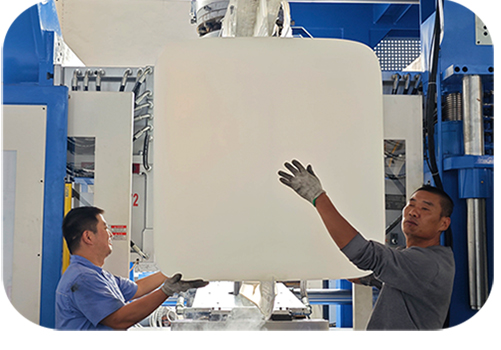
The shape of the IBC tank creates uneven stress
An IBC tank is not a simple box. It has a filling opening, shoulder structure, side panels, corners, lower support area, valve opening, and contact zones with the steel cage and pallet. Each area experiences different forces during filling, lifting, stacking, transport, and discharge. The bottle must also fit inside the cage without excessive clearance or pressure points.
This means the mold must be designed with the final assembly in mind. If the bottle is too wide, insertion becomes difficult. If the corners are too weak, the tank may deform. If the valve area is not stable, leakage risk increases. If the top opening is not accurate, cap sealing and handling become unreliable. Mold design should therefore consider the entire IBC tank system, not only the appearance of the plastic inner bottle.
Parison programming is the foundation
In extrusion blow molding, molten HDPE exits the die head as a parison before the mold closes. For large IBC tanks, the parison is heavy and affected by gravity. It stretches while hanging, and different sections of the final bottle require different material thickness. Parison programming allows the machine to adjust the material distribution along the length of the parison so that critical areas receive enough material.
A suitable IBC tank blow molding machine should offer repeatable parison control and stable extrusion. If output fluctuates, the wall thickness changes. If melt temperature is unstable, the parison may sag differently. If the die head is not suitable for the product size, material distribution becomes difficult to control. Buyers should ask how the supplier controls these variables, especially for 1000L IBC tanks.
Cooling design affects both cycle time and quality
Cooling is not only about production speed. It also affects shrinkage, dimensional stability, surface quality, and stress distribution. An IBC tank mold needs an effective cooling channel design so that thick and thin areas stabilize properly. If cooling is uneven, the bottle may deform after demolding or fail to maintain consistent dimensions during assembly.
Faster cooling can improve output, but aggressive cooling without proper design may create stress or surface problems. The supplier should match the mold cooling system with the machine, chiller or cooling tower, water quality, and factory environment. In hot climates, cooling capacity becomes especially important for stable production.
The shoulder and top opening require precision
The top section of an IBC tank is more important than it appears. The filling opening must support cap sealing, filling operation, and handling. The shoulder must connect the top opening to the body without thin areas or weak transitions. If the neck is poorly formed, the container may have sealing problems, difficult cap assembly, or inconsistent appearance.
During mold design, the shoulder shape should support smooth material flow. During production, operators need to monitor the neck and shoulder for flash, deformation, and thickness variation. A high-quality mold and stable machine reduce the need for excessive trimming and rework.
The valve area is a common risk point
The lower valve area carries both functional and sealing requirements. It must be positioned accurately and formed with enough strength. A weak valve boss or poor surrounding thickness can create leakage problems or customer complaints. Because the valve area is near the lower section of the bottle, material distribution and cooling must be carefully controlled.
Buyers should pay attention to how the supplier designs and tests this area. A quotation that only mentions the main machine may not provide enough confidence. Ask about mold design experience, sample testing, valve compatibility, and inspection methods. The valve area should be evaluated before mass production begins, not after defective products appear.
Weight reduction must be handled carefully
Many manufacturers want to reduce bottle weight to improve cost competitiveness. Weight optimization can be valuable, but it must be based on data. Reducing weight without understanding stress areas may increase rejection rates or damage the brand. A responsible optimization program checks product performance, wall thickness, drop-related behavior, stacking needs, leakage performance, and customer application.
Instead of asking simply for the lowest possible weight, buyers should define the target use and quality standard. Then the supplier can help adjust parison settings, mold design, cooling, and process conditions. A stable lightweight design is more valuable than a low quoted weight that cannot be repeated in production.
Mold quality influences long-term maintenance
IBC tank molds are large, expensive, and central to production stability. Mold material, machining accuracy, cooling-channel design, venting, surface treatment, and ease of maintenance all influence the line’s performance. Poor mold quality can create flash, uneven cooling, short service life, and frequent downtime.
When comparing suppliers, ask about mold design process, machining capability, cooling layout, spare parts, expected maintenance, and sample approval. Also confirm whether the mold is designed for the specific bottle drawing or simply adapted from an existing model. A custom project should begin with container requirements, not with a generic mold assumption.
What a buyer should inspect during trials
During machine acceptance or sample production, do not only look at whether the bottle can be formed. Check the product weight over multiple cycles, wall thickness at critical areas, neck dimensions, valve area, surface quality, flash condition, cooling time, demolding stability, and repeatability. Ask for samples from continuous operation, not only the best product shown after adjustment.
If possible, assemble the inner bottle with the steel cage and pallet. This confirms whether the molded product fits the rest of the IBC tank system. A bottle that looks acceptable alone may create problems during final assembly. The best test is always connected to the finished product.
Strong packaging begins before the first production shift
Mold design and wall thickness control may seem technical, but they have direct business impact. They affect material cost, cycle time, scrap, customer complaints, and product reputation. A well-designed IBC tank production line does more than mold a large container. It creates repeatable industrial packaging that performs under real handling conditions.
For buyers planning a new IBC tank production line, the supplier’s experience in mold design, parison control, cooling, and quality testing should be evaluated as carefully as the machine price. A strong mold and stable process can protect the investment for many years.