Home » About Us » HUAN News » Blog » Energy Saving 220L Drum Blow Molding Machine: Where Electricity, Cooling, and Material Costs Are Really Controlled
Energy Saving 220L Drum Blow Molding Machine: Where Electricity, Cooling, and Material Costs Are Really Controlled
Views: 1 Author: Site Editor Publish Time: 01-08-2026 Origin: Site
An energy saving 220L drum blow molding machine should be evaluated by real operating cost, not by a slogan. Large HDPE drums require heavy parisons, strong clamping, mold cooling, hydraulic movement, air, water, and continuous material handling. Electricity matters, but energy saving also depends on cooling efficiency, cycle stability, product weight control, and preventive maintenance.
For chemical packaging factories, operating cost accumulates every day. A machine that wastes material or runs unstable cycles can be more expensive than a machine with a higher initial price. Buyers should therefore ask how the 220L HDPE drum blow molding equipment controls material distribution, cooling time, hydraulic power, and scrap.
Energy cost begins with process stability
A stable extrusion process reduces rejected drums, unnecessary heating correction, and repeated start-up waste. If melt pressure fluctuates or material feeding is inconsistent, wall thickness may vary and products may require higher weight to pass strength expectations. The cheapest energy is the energy not spent making rejected products.
Energy-Related Area
How It Affects Cost
Buyer Check
Extrusion stability
Unstable melt creates scrap and heavy safety margins
Ask for temperature and pressure control method
Mold cooling
Poor cooling extends cycle time
Confirm cooling channel design and water requirements
Hydraulic system
Inefficient movement increases power use and heat
Review system design and maintenance access
Compressed air
Air leaks and oversized demand waste utilities
Check air pressure and consumption estimate
Scrap rate
Rejected drums consume full material and energy
Ask for trial data and rejection causes
Product weight control can save more than motor efficiency
For a 200L 220L drum blow molding machine, material cost is often more important than electricity. If poor wall-thickness distribution forces the factory to add extra HDPE to every drum, the long-term cost can be significant. Good parison control places material in rings, corners, shoulder, base, and body areas according to stress instead of making the entire drum heavier.
Weight Control Item
Cost Impact
Control Method
Parison programming
Reduces unnecessary material in low-stress areas
Use wall-thickness control based on drum geometry
Mold cooling balance
Prevents deformation that forces weight increase
Check water channels and temperature stability
Ring formation
Supports strength without overbuilding entire drum
Mold design around double L-ring or handling areas
Sampling plan
Detects drift before large batches are affected
Weigh and measure drums regularly
Operator training
Prevents random setting changes
Use recipe control and process discipline
Cooling efficiency is a hidden production multiplier
In large-container blow molding, cooling time often limits output. If cooling water is too warm, flow is insufficient, or channels are poorly designed, the drum may need a longer cycle or may deform after demolding. An energy-saving line should consider cooling system design, water quality, pump efficiency, and mold maintenance.
Cooling Issue checklist:
·Insufficient water flow: Production Symptom: Longer cycle or unstable dimensions; Cost Result: Lower output per shift.
·High water temperature: Production Symptom: Soft drum after demolding; Cost Result: More deformation and rejection.
·Blocked cooling channel: Production Symptom: Hot spots in specific areas; Cost Result: Inconsistent wall and shape.
·Poor maintenance: Production Symptom: Gradual cycle increase; Cost Result: Higher energy per accepted drum.
·No monitoring: Production Symptom: Problems found too late; Cost Result: Large batch risk.
Quick note: Energy saving is real when - The line reduces rejected drums, controls product weight, shortens stable cycle time, maintains cooling efficiency, and keeps utilities within planned demand. Energy saving is weak when - The quotation only mentions a motor or control brand without showing operating assumptions, cooling requirements, or accepted output data.
High speed and energy saving must be balanced
Alarge volume HDPE drum blow molding machine can advertise high output, but speed should not create overheating, unstable cooling, or higher rejection. Similarly, a line described as energy saving should not be so slow that unit cost rises. Buyers should compare energy per accepted drum under realistic conditions, not only connected power.
Performance Metric checklist:
·Connected power: Incomplete View: Total installed kW; Better View: Actual operating consumption per accepted drum.
·Cycle time: Incomplete View: Fastest short trial cycle; Better View: Stable cycle during production run.
·Drum weight: Incomplete View: Nominal design weight; Better View: Average weight and variation over batches.
·Scrap: Incomplete View: Start-up rejected pieces ignored; Better View: Total scrap during normal and changeover production.
·Maintenance: Incomplete View: No planned checks; Better View: Preventive routine that protects efficiency.
What to ask before purchasing
Before choosing an energy saving 220L drum blow molding machine, buyers should request operating assumptions, utility schedule, cooling requirements, product weight data, trial output, and maintenance recommendations. The supplier should explain how the machine saves cost in daily operation, not only why the machine looks efficient on paper.
For a practical calculation, buyers can request an operating cost estimate or send your drum weight and daily output. The result should compare material, electricity, cooling, labor, scrap, and downtime. Energy saving is not one feature. It is the combined result of stable extrusion, efficient cooling, controlled weight, clean material handling, and disciplined maintenance.
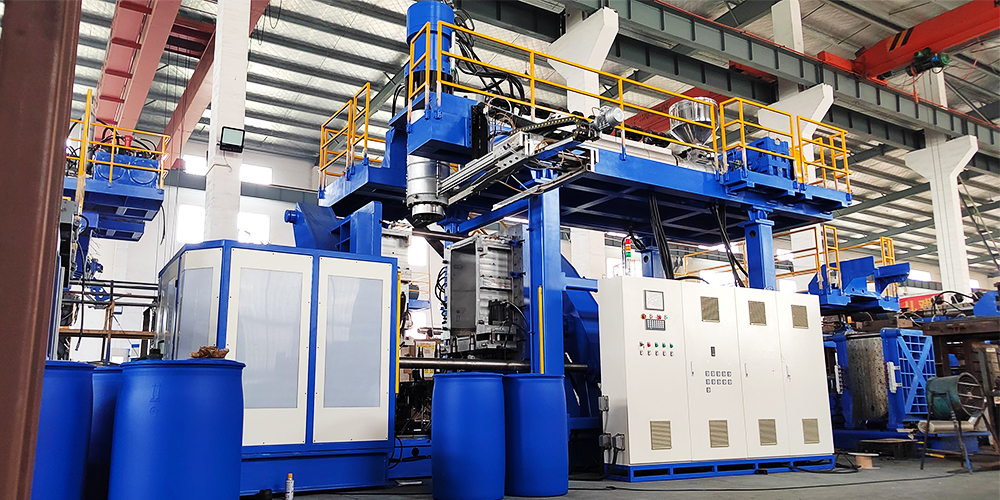
Suggested image layout: Opening - 220L drum machine in production (ALT: energy saving 220L drum blow molding machine for HDPE chemical drums); Weight section - Wall-thickness control graphic (ALT: 200L 220L drum blow molding machine parison control and weight consistency); Cooling section - Mold cooling or utility system (ALT: 220L HDPE drum blow molding equipment cooling system for stable production).
Train operators to protect the energy-saving result
Even a well-designed machine can lose efficiency if operators constantly change settings without a process reason. Training should cover recipe management, start-up procedure, cooling-water checks, material feeding, wall-thickness sampling, and basic maintenance. Energy saving is sustained by discipline. It is not achieved only on the first day of commissioning.
Training Topic checklist:
·Start-up procedure: Operator Habit to Build: Reach stable temperature and pressure before production; Efficiency Benefit: Reduces early scrap.
·Recipe control: Operator Habit to Build: Avoid random temperature or speed changes; Efficiency Benefit: Protects repeatability.
·Cooling check: Operator Habit to Build: Monitor water temperature and flow; Efficiency Benefit: Prevents long cycle drift.
·Weight sampling: Operator Habit to Build: Detect material overuse quickly; Efficiency Benefit: Controls resin cost.
·Maintenance reporting: Operator Habit to Build: Report leaks, noise, or temperature abnormality; Efficiency Benefit: Prevents energy waste and downtime.
For buyers, this means supplier training should be treated as part of the energy-saving package. A strong machine plus weak operating habits will not deliver the expected cost advantage.
Buyers can also ask suppliers to separate one-time utility peaks from normal production demand. Start-up, heating, and simultaneous auxiliary operation may create a different demand profile from stable running. This matters when factories must size transformers, chillers, compressors, and water circulation systems. A correct utility plan avoids oversizing in one area and undersizing in another.
Utility Planning Detail
Question to Ask
Decision Benefit
Peak vs normal power
What is the expected operating demand after warm-up?
Supports correct electrical planning
Cooling capacity
What water temperature is required for the stated output?
Protects cycle stability
Air consumption
Which stations use compressed air and at what pressure?