Home » About Us » HUAN News » Blog » What a 220L Drum Drop Test Reveals About Machine Settings, Mold Design and Quality Control
What a 220L Drum Drop Test Reveals About Machine Settings, Mold Design and Quality Control
Views: 1 Author: Site Editor Publish Time: 22-10-2026 Origin: Site
A drum fails a drop test. The immediate reaction may be to increase its weight, change the resin, or blame the mold. None of those actions is justified until the failure is described carefully. A split at a corner, a crack near a pinch-off, and a leak at the closure point to different technical questions. The value of a drop test lies not only in its pass or fail result but in the evidence it provides about how the drum distributes stress and how consistently the manufacturing process reproduces the intended structure.
Record the failure before moving the sample
Document the test configuration, filling condition, temperature conditioning, drop orientation, impact surface, and applicable method. Photograph the drum before and after the test, including the exact origin of any crack or leak. Keep the failed specimen for examination. If the packaging is subject to dangerous-goods requirements, the relevant approved test procedure and certification process govern; a development trial in the factory must not be presented as proof of compliance. The same discipline is useful for nonregulated industrial packaging because it makes different trials comparable.
Failure location
Question to investigate
Useful evidence
Base corner
Was local wall distribution sufficient?
Thickness section and impact photo
Pinch-off seam
Was the weld region properly formed?
Cross-section and tooling inspection
L-ring or shoulder
Did geometry concentrate the load?
Mold drawing and fracture location
Bung area
Did the closure or top panel deform?
Closure fit and sealing record
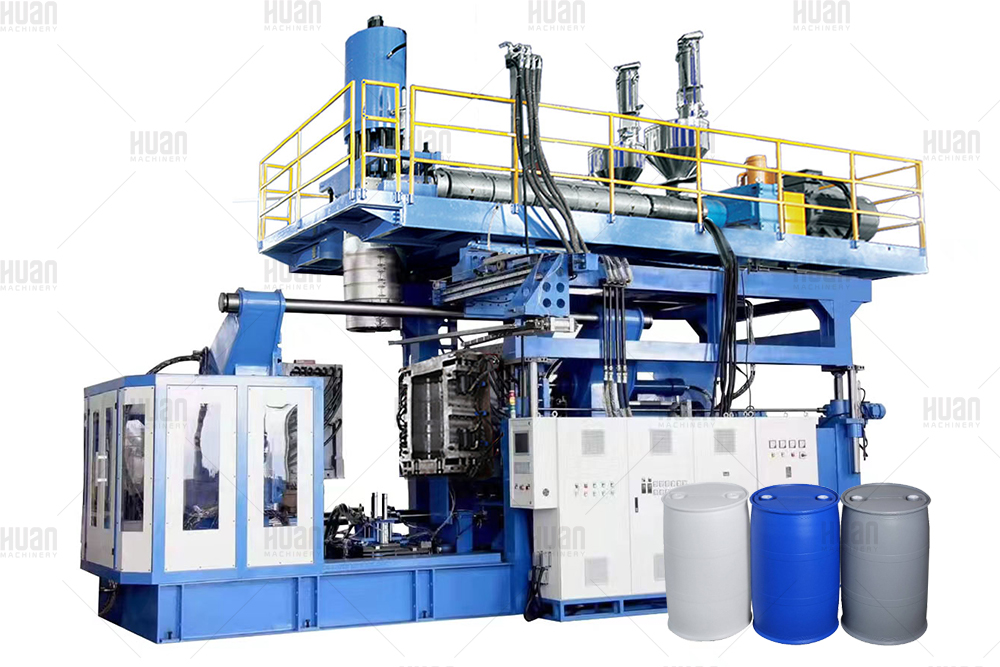
The 220L HDPE drum blow molding equipment must be evaluated as part of this evidence chain. A machine that creates a stable parison and repeatable molding cycle supports consistent drum quality, but it cannot make a poorly designed geometry immune to impact. Conversely, a sound design can fail if local wall thickness or joining conditions drift outside the approved process window.
Separate design weakness from process variation
If every tested sample fails in the same location under comparable conditions, examine the design, material specification, and tooling. If only some samples fail, investigate process consistency and the distribution of critical dimensions across production. Compare failed and passed drums from the same run, then compare different production periods. The most useful evidence may be a wall-thickness map showing that a small region is thinner in the failed group. A single average drum weight cannot reveal that local difference.
A 200L 220L drum blow molding machine can offer parison programming, but adjustments must be evaluated across the whole drum. Moving material toward one vulnerable region can reduce thickness elsewhere. Use controlled trials and assess the relevant load paths rather than tuning only to the most recent failure. The accepted solution should work across representative material lots and normal operating conditions, not only for a specially prepared demonstration sample.
Do not confuse toughness with mass
A heavier drum is not automatically better. Material grade, processing history, temperature, geometry, and local thickness distribution all influence impact behavior. If a failure begins at a sharp transition or a weak weld, adding material to unrelated panels may increase cost without solving the cause. Ask whether the selected HDPE grade suits the application and whether the processing conditions preserve consistent material behavior. Changes to resin grade or recycled content should be evaluated against the customer's specification and any applicable regulatory constraints.
Proposed change
What it may improve
What must be checked
Local parison adjustment
Thickness at a weak region
Other regions do not become underweight
Mold geometry revision
Stress concentration
Fit, handling and tooling feasibility
Material change
Impact response
Processability and customer approval
Cooling adjustment
Residual stress or deformation
Cycle and dimensional stability
Build a failure investigation sequence
Begin with containment: identify affected lots and prevent shipment if the failure is relevant to the product's release requirements. Next, confirm the test setup and repeatability. Then map the failure, measure the local structure, and review process records. Select one hypothesis for a controlled trial. Finally, test representative production samples under the approved method and update the control plan. This sequence is slower than immediately changing five settings, but it avoids losing the cause among uncontrolled variables.
For an energy saving 220L drum blow molding machine, buyers may focus on electricity and cycle time. Those figures matter only alongside qualified output. A lower-energy setting that increases failed drums can worsen cost per accepted unit. The correct comparison uses material consumed, operating energy, scrap, and inspection outcomes under equivalent production conditions.
Investigation stage
Output
Decision gate
Containment
Defined suspect batch
Shipment hold or release review
Test verification
Confirmed method and setup
Is the failure reproducible?
Root-cause trial
One controlled technical change
Did the failure mode improve?
Requalification
Representative accepted samples
Can normal production resume?
Read the fracture pattern carefully
The visible crack path can help distinguish an impact concentration from a weak joining region, although it rarely proves a cause by itself. Photograph both sides of the damaged area and identify where the crack appears to begin. Compare with a section from a passed drum made under similar conditions. If the failure crosses a pinch region, examine its geometry and material continuity. If it begins at a sharp transition, review the design and local thickness. Avoid making a permanent tooling change until the hypothesis is supported by repeated evidence.
Build a fair comparison between process settings
Two trials should use the same drum drawing, material specification, conditioning procedure, and approved test method. If a new parison profile is being evaluated, hold other variables as constant as practical. Collect multiple representative samples and include ordinary production variation. A single successful drop does not establish repeatability, and a single failure may require investigation of the test setup. Document all results, including unsuccessful trials, so the engineering team does not repeat the same experiments later.
Link impact performance to operating economics
Resin is a major variable cost in large-drum production, but a lighter drum is not automatically the least expensive option if it fails qualification. Compare accepted units per unit of resin and the cost of rejected or returned product. Include the time needed for process stabilization after a recipe change. A technically sound improvement protects the approved performance requirement while reducing unnecessary material or variability. The purchasing decision should reward repeatable accepted output rather than a dramatic demonstration of low finished weight.
Another useful comparison is the relationship between fracture location and handling orientation. A drum may be robust in one orientation and vulnerable in another because impact loads reach different structural features. The test program should reflect the approved application and applicable method, rather than choosing only the easiest orientation. Record which configuration produced each result and do not combine unlike tests into a single pass-rate figure. That level of detail turns a failed specimen into useful design evidence.
Use test evidence when buying equipment
Ask the supplier to show how the 220L drum full production line controls local wall distribution, trimming, cooling, and product inspection. Request a trial plan based on the buyer's drum drawing and target market, not a generic claim of strength. If the customer expects a specific transport test, agree on who performs it, what sample population is used, and what documentation is delivered. Avoid comparing unrelated test results taken at different temperatures, fill levels, or impact conditions.
If a drum has failed qualification, request a 220L drop-failure investigation with photos and test details. If you are planning a new product, contact us about a drum validation trial before approving tooling. A useful drop test turns a failure into a focused engineering question. The purpose is not to chase one passing specimen; it is to establish a repeatable manufacturing process that produces acceptable drums under the intended conditions.