Home » About Us » HUAN News » Blog » High Speed Jerry Can Blow Molding Machine: When Faster Output Creates Value and When It Creates Waste
High Speed Jerry Can Blow Molding Machine: When Faster Output Creates Value and When It Creates Waste
Views: 2 Author: Site Editor Publish Time: 31-07-2026 Origin: Site
A high speed jerry can blow molding machine can be a strong investment when the entire production system is ready for high output. It can also create waste when downstream stations cannot keep up. Speed has value only when finished jerry cans are trimmed, tested, cooled, handled, and packed without creating a new bottleneck.
Many buyers ask for the fastestjerry can blow molding machine production line because they want lower unit cost. That goal is reasonable, but speed should be measured as qualified containers per shift, not only cycle time. For lubricant, chemical, agrochemical, and industrial-liquid packaging, every extra container must still meet appearance, neck accuracy, handle strength, leak performance, and packaging requirements.
Define useful speed before comparing machines
Useful speed means the line produces accepted products at a rate the factory can sell, inspect, and pack. If a machine makes more containers than the testing station can check, products accumulate. If trimming requires too much manual correction, operators become the limit. If cooling is insufficient, dimensions may drift. The supplier should discuss the complete system instead of quoting a single output number.
Speed Claim
Question to Ask
Better Measurement
Cycle time
What container size, weight, and material were used?
Qualified containers per hour
Pieces per day
How many operating hours and stops are assumed?
Accepted output per paid shift
Fully automatic output
Which operations remain manual?
Labor hours per accepted container
High-speed trimming
Can trimming keep pace with molding?
Bottleneck-free downstream rate
Stable continuous operation
How long was the test run?
Output during a realistic production run
Where high speed actually creates value
A fast machine is valuable when product design is stable, orders are large, color changes are limited, operators are trained, and downstream equipment is synchronized. In this situation, an automatic jerry can blow molding machine can reduce unit labor cost, improve flow, and support large orders for lubricant or chemical packaging customers.
Factory Condition checklist:
·Large repeat orders: Speed Value: High; Reason: Long production runs spread start-up time across many units.
·Automated trimming and testing: Speed Value: High; Reason: Downstream stations can match molding output.
·Strict delivery schedules: Speed Value: Medium to high; Reason: Higher capacity creates scheduling flexibility.
·Many colors and small batches: Speed Value: Low to medium; Reason: Changeover time may offset speed advantage.
Quick note: Speed creates value when... - The factory has balanced conveyors, trimming, leak testing, cooling, packaging, and trained maintenance. The product is repeated often enough to justify stable recipes. Speed creates waste when... - Operators manually chase products, reject rates rise, neck trimming cannot keep pace, or the warehouse cannot absorb finished jerry cans.
Bottlenecks that buyers often miss
The main machine may not be the slowest station. In acontinuous jerry can blow molding machinesetup, the actual limit may be neck trimming, leak testing, labeling, packing, scrap collection, or forklift movement. Buyers should map every operation from material feeding to palletized product.
Bottleneck
Warning Sign
Improvement Option
Neck trimming
Operators rework rough openings or threads
Add accurate trimming fixture or automation
Leak testing
Finished cans wait before testing
Use matched testing capacity and clear rejection route
Cooling
Containers deform after stacking
Improve mold cooling and post-cooling handling
Scrap handling
Flash piles near machine
Install automatic scrap conveyor and crusher
Packing area
Conveyors stop while products wait
Plan storage, stacking, and packing flow
Do not trade product quality for speed
A 25L jerry can has critical areas: handle, neck, shoulder, corners, base, and side panels. Higher speed can shorten cooling time or reduce process margin if the machine and mold are not designed correctly. A strong supplier should show how parison control, mold cooling, clamping stability, and extrusion consistency support the required speed.
Product Area
Quality Risk at High Speed
Control Method
Handle
Thin area or weak grip
Wall-thickness program and mold design
Neck
Poor cap fit or rough trimming
Accurate neck mold and trimming process
Base
Rocking or deformation
Cooling and base design control
Corners
Thin spots after stretching
Parison distribution and mold cooling
Surface
Flow marks or color variation
Stable material feeding and temperature control
How to specify a high-speed project
To compare a high speed jerry can blow molding machine, send target size, bottle weight, handle type, neck size, cap or closure requirement, material, color plan, daily output, and available utilities. If the factory requires frequent color changes, the quotation should include material handling and cleaning strategy, not only the main machine.
Buyers canrequest a capacity matching planor send your product size and target output before choosing a machine. The goal is to buy the fastest useful line, not the fastest advertised machine. A line that keeps molding, trimming, leak testing, scrap recovery, and packing in balance will usually produce a lower real unit cost than a machine that only wins on speed claims.
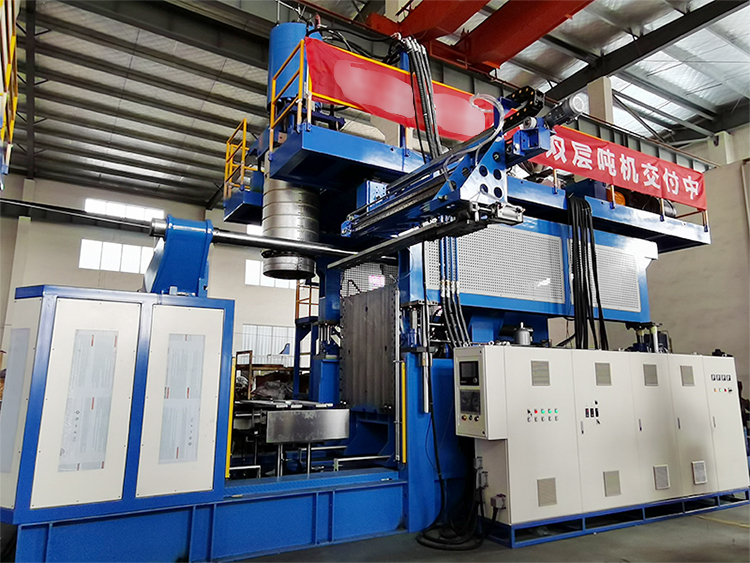
Suggested image layout: Opening - High-speed machine with products (ALT: high speed jerry can blow molding machine for industrial packaging); Bottleneck section - Production flow diagram (ALT: jerry can blow molding machine production line from molding to leak testing and packing); Quality section - Handle and neck close-up (ALT: 25L jerry can handle and neck quality in high speed blow molding production).
Use product mix to decide the useful speed level
Speed requirements change when the factory produces several container sizes or colors. A long run of the same 25L lubricant jerry can can use high-speed production efficiently. A factory that changes between 10L, 20L, 25L, and 30L products may lose time in mold change, color cleaning, recipe adjustment, and trial inspection. The machine should be selected around monthly product mix rather than one ideal product.
Product Mix checklist:
·One main size and color: Recommended Speed Strategy: High speed line with automated downstream; Reason: Long production runs maximize machine output.
·Several sizes but stable colors: Recommended Speed Strategy: Flexible machine with planned mold change; Reason: Changeover must be organized.
·Frequent color changes: Recommended Speed Strategy: Material handling and cleaning efficiency matter most; Reason: Downtime may exceed speed advantage.
·Small custom orders: Recommended Speed Strategy: Moderate speed and faster setup may be better; Reason: Flexibility protects delivery schedule.
·High-volume contract supply: Recommended Speed Strategy: High-speed automated line is easier to justify; Reason: Output demand is predictable.
For this reason, buyers should share not only target maximum output but also order structure. A supplier who understands the order mix can recommend a line that produces real business value instead of an impressive output number that is rarely used.