Home » About Us » HUAN News » Blog » Expanding from an IBC Blow Molding Machine to a Complete IBC Tank Production Line Without Rebuilding the Factory
Expanding from an IBC Blow Molding Machine to a Complete IBC Tank Production Line Without Rebuilding the Factory
Views: 1 Author: Site Editor Publish Time: 12-08-2026 Origin: Site
Why many IBC projects should not start with the final factory layout
A new IBC project often begins with one urgent question: how much investment is needed to start production? The answer depends on whether the buyer wants immediate full-line automation or a practical path from the first IBC blow molding machine to a broader production system. For many emerging packaging producers, the best decision is not to buy everything on day one. It is to build the plant so that later equipment can be added without moving every machine, rewiring the building, or stopping production for weeks.
Phased expansion is not the same as buying a small machine and hoping it will fit the future. A phased plan defines the targetIBC tank production linefirst, then chooses which functions can be manual, semi-automatic, or prepared for later automation. The buyer needs to know where the cage area will be located, where assembly will happen, how scrap will return to material handling, and how finished IBC tanks will leave the workshop. When those routes are planned early, the factory can grow without disorder.
This article is useful for buyers who have already studied a basicIBC tank making machineand now need to decide how to protect future capacity. It focuses on layout reservations, modular equipment choices, utilities, and management checkpoints rather than only listing machine parameters.
Reserve the future flow before purchasing the first machine
The most valuable asset in a growing IBC factory is not only floor area; it is clear movement. Resin should move toward the plastic section without crossing finished-goods traffic. Steel tubes should enter cage preparation close to cutting and welding. Pallets, valves, closures, and labels should be stored near assembly but outside the forklift route. If these routes are missing, the factory may produce IBC tanks but lose time through repeated handling.
Before placing the first extrusion blow molding machine, buyers should mark the future locations of cage fabrication, assembly, testing, reject handling, and finished-goods staging. The first layout may operate with forklifts and manual assembly, but the floor should still leave straight zones for conveyors or transfer systems. A good IBC production line supplier will not only quote equipment; it should help the buyer request a phased layout that shows both the initial stage and the later upgrade path.
Balance bottle output with cage and assembly speed
Adding equipment without utility capacity
Full-line stage
Integrated cage, assembly, testing, transfer and data collection
Reduce handling and stabilize repeatability
Automating a weak manual process without process standards
Choose modular functions without creating weak links
Not every function must be automated at the same time. Material feeding and cooling stability are usually more urgent than automatic finished-product handling, because unstable feeding and cooling can create quality variation from the first day. Cage welding may be outsourced at the beginning in some markets, but that decision must be evaluated against transport cost, cage tolerance, and assembly efficiency. Leak testing should never be treated as optional if the product is sold for chemical or industrial liquid packaging.
When buyers compare quotations, they should ask which modules can be added later. Can the control cabinet accept extra downstream signals? Is there space for an automatic deflashing station? Can the layout connect to a future cage line? Can the compressor, chiller, and electrical supply support planned expansion? These questions protect the buyer from a low-cost start that becomes expensive to upgrade.
Area
Why it matters
Planning question
Cage fabrication
Cage tolerance affects assembly speed and container protection
Will cages be produced in-house now or after expansion?
Assembly and testing
Final quality is created and confirmed here
Can operators reach valves, closures, labels and reject zones safely?
Scrap handling
Flash and rejected parts need controlled movement
Can scrap return without crossing clean material routes?
Finished IBC tank storage
Large containers require serious floor space
How many accepted units must wait before loading?
Utilities must be sized for the target plant
A common mistake is designing utilities only around the first installed machine. Large blow molding machines need stable power, cooling water, compressed air, and maintenance access. Later cage welding equipment, trimming, conveying, leak testing, and assembly devices also add load. If the building infrastructure is too limited, expansion may require new cable routes, larger transformers, stronger air systems, and downtime during rebuilding.
The buyer does not need to install every utility at full size on day one, but the plant design should leave a clear upgrade path. Cable trays, pipe routes, drainage, chiller room space, and compressor location should be considered before machine arrival. Sending drawings early helps the supplier send your workshop dimensionsand calculate what must be prepared immediately and what can be reserved for later.
A practical expansion plan should include people and quality systems
Phased expansion is not only mechanical. Operators, maintenance teams, and quality inspectors must learn new routines as automation increases. In the start-up phase, managers may rely on skilled operators to move bottles, position cages, install valves, and inspect appearance. In the growth phase, the team must shift from manual coordination to system monitoring, recipe control, data recording, and preventive maintenance.
A well-prepared factory creates standard operating procedures before the line becomes complex. Wall-thickness measurement points, leak-test rules, cage inspection items, scrap-control rules, and shift handover records should be used from the first production stage. These practices make later automation smoother because the factory already knows which data matter.
Feature
Initial benefit
Expansion benefit
Control interface
Recipe control and alarms
Downstream coordination with transfer and testing
Utility schedule
Correct installation preparation
Easier chiller, compressor and electrical expansion
Layout drawing
Safer installation
Lower cost when adding future modules
Training documents
Stable start-up
Faster transfer of knowledge to new operators
Procurement notes for phased expansion
Procurement teams should separate what must be purchased immediately from what only needs reserved space and utility preparation. The first quotation can include the main machine, mold, basic trimming, leak testing, and installation support, while the project drawing still reserves space for cage production, automatic assembly, and finished-container transfer. This helps the buyer control investment without losing the future direction of the plant.
When reviewing proposals, the buyer should ask each supplier to mark included, optional, future-ready, and buyer-prepared items. This prevents confusion between a low-priced start-up package and a true expansion-ready system. The strongest proposal is not always the biggest one. It is the one that allows the plant to produce safely now and expand with fewer interruptions later.
Sales and production teams should also agree on the first target market. If the initial customers need only local industrial packaging, a modular start may be enough. If the buyer already has contracts with large chemical groups, faster cage supply, better data records, and more automated testing may need to be installed earlier.
Publishing note for IBC project pages
When this article is published, it should not stand alone as an isolated blog post. It should connect to the client’s IBC product pages, related production-line pages, and inquiry page through the red anchor texts already marked in the body. This internal-link path helps a reader move from educational content to equipment selection without feeling pushed too early.
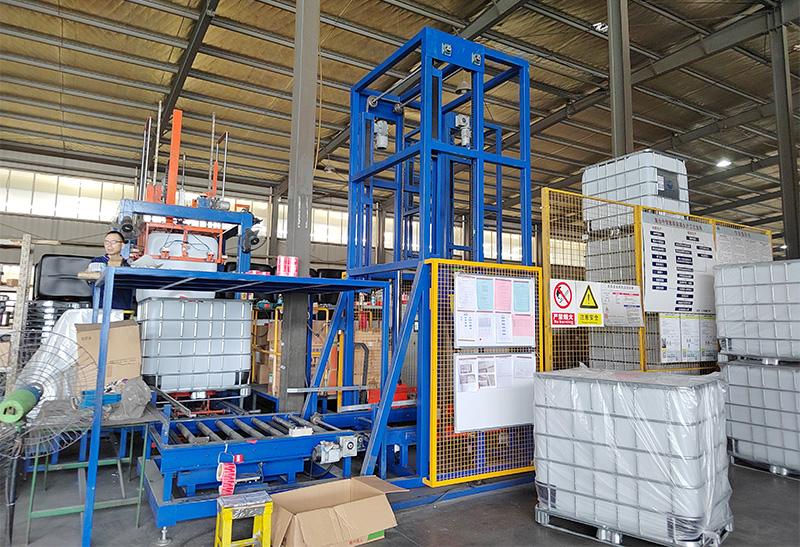
The page should also include one real workshop image, one process-detail image, and one finished IBC tank or layout image. These images make the article easier to scan and help the page feel more original than competitor pages that rely only on machine parameter lists. The primary keyword, IBC tank production line, should stay in the title, introduction, one subheading if natural, and the SEO fields, but it should not be repeated mechanically.
Final thought: design the first stage as part of the final system
The safest expansion strategy is to treat the first equipment package as the first chapter of the target IBC full production line. Buyers should avoid isolated purchases that solve today’s production problem but block tomorrow’s growth. A phased plan with reserved space, matched utilities, standard quality records, and upgrade-ready control logic can reduce risk and protect investment. The result is a factory that starts with manageable cost and grows into a complete IBC tank production system without unnecessary rebuilding.